Artículo de investigación
Vol. 1 | 2026 (English)
24 min
Autonomy or paternalism? Tensions in healthcare decision-making for older adults in Chile
¿Autonomía o paternalismo? Tensiones en la toma de decisiones sanitarias de adultos mayores en Chile
Veronika Wegner-Astudillo1* | 1Facultad de Derecho, Universidad Adolfo Ibáñez, Viña del Mar, Chile
*Correspondencia:
*Veronika Wegner-Astudillo. veronika.wegner@uai.cl
Recepción:
04/06/2026
Aceptación:
02/10/2026
Publicación:
27/10/2026
Métricas
42
Visualizaciones
7
Descargas
Compartir
Compartir
Resumen (EN)
The rapid aging of the Chilean population has led to a significant increase in physician-patient interactions. These interactions are legally complex, creating major challenges regarding capacity, autonomy, consent, and the effective protection of rights. Against this backdrop, this study focuses on a specific aspect of healthcare issues: decision-making by older patients within the context of standardized or institutionalized contractual practices for care services. It uses the contracts employed by “Establecimientos de Larga Estadía para Adultos Mayores” (Long-term care facilities for older adults) or ELEAM as a paradigmatic case study. Specifically, it examines the requirement for a third party to appear as a “designated representative” and the powers granted to them regarding decisions that directly affect the resident’s personal sphere—as a form of violence against older adults.
Palabras clave (EN):
Health law
Older adult
Autonomy
Paternalism
Violence
Resumen (ES)
El envejecimiento acelerado de la población chilena ha implicado un aumento relevante en las interacciones médico-paciente, que en cuanto a lo jurídico resultan complejas, generando desafíos importantes en materia de capacidad, autonomía, consentimiento y protección efectiva de sus derechos. Dado este escenario, nos interesa referirnos a un acápite particular en la problemática sanitaria, y que corresponde a la toma de decisiones de los pacientes mayores, a la luz de las prácticas contractuales que están normalizadas o institucionalizadas en la contratación de ciertos servicios de cuidado, utilizando como caso paradigmático las prácticas contractuales empleadas en la contratación de servicios de cuidado por parte de Establecimientos de Larga Estadía para Adultos Mayores (ELEAM). En particular, se examina la exigencia de la comparecencia de un tercero como “apoderado” y las facultades que se le atribuyen respecto de decisiones que inciden directamente en la esfera personal del residente, como una forma de manifestación de violencia contra las personas mayores.
Palabras clave (ES):
Derecho sanitario
Adulto mayor
Autonomía
Paternalismo
Violencia
Introduction
The sustained and rapid aging of the population, as well as low birth rates in Chile and around the world, are realities that we cannot ignore or hide. According to the latest figures presented by the competent authority, «an increase in the percentage of people aged 65 or older is observed, reaching 14% in the 2024 Census, whereas 32 years earlier, in 1992, it was 6.6% (8.1% in 2002 and 11.4% in 2017). At the same time, a decrease in the percentage of people aged 14 or younger is observed from 29.4% in 1992 to 17.7% in 2024 (25.7% in 2002; 20.1% in 2017)» (National Institute of Statistics, 2025). Thus, the Aging Index in Chile for the year 2024 shows that «for every 100 people aged 14 or younger, there are 79 people aged 65 or older». Just over 30 years ago, that figure was 22.3.
These figures imply—among many other matters—a significant increase in doctor-patient interactions, which legally are undoubtedly complex. Issues such as the scope of rights and obligations of older patients, civil liability, informed consent, the provision of goods and services, and the existence of adequate public policies become core concerns.1
Given this scenario, we are interested in delving into a specific aspect of the healthcare problem: decision-making by older adults in Chile, in light of contractual practices that are standardized or institutionalized in contracting certain care services, as a form of violence against older adults.
Specifically, and based on certain reviewed contractual practices available online, it is possible to notice a structural tension between the individual autonomy of the older adult and what we will call “paternalistic” practices. These issues result in an impairment of the older person’s consent as an expression of their self-determination. We will establish that these practices do not align with applicable domestic and international regulations, which are violated by such practices, to finally demonstrate how depersonalization and infantilism in these matters translate into a form of violence against older adults, an issue that is resolved not only through formal recognition of the healthcare autonomy of older adults, but by guaranteeing its effective exercise.
In this vein, we will first refer to the paradigmatic case that motivates this analysis, corresponding to older adults contracting with Long-Term Care Facilities for Older Adults (hereinafter ELEAM), identifying contractual practices that directly affect their autonomy. Secondly, we will review the constitutional, legal, and treaty-based rules relevant to establishing the compatibility of such contractual stipulations with the Chilean legal system. Thirdly, we will address the relationship between legal capacity and autonomy of older adults, particularly in the healthcare field, thus distinguishing between legally recognized capacity and factual barriers that limit its exercise. Fourthly, we will develop the notions of depersonalization and infantilization as forms of violence against older adults. Lastly, we will formulate the main conclusions regarding the need to transition from a paternalistic and substitute model toward one that recognizes and effectively guarantees the autonomy of older adults.
Methodologically, the study adopts a qualitative, legal-dogmatic, and documentary approach, considering for this purpose the analysis of model ELEAM contracts publicly available online, complemented by the examination of applicable national and international provisions in this area, as well as relevant doctrine on legal capacity, autonomy, consent, and violence against older adults. The examination considers—among others—the provisions contained in Articles 1, 19 No. 1 and 9 of the Political Constitution of the Republic; Articles 1446 and 465 of the Civil Code; Law No. 20,584, which regulates the rights and duties of individuals regarding actions linked to their health care, of April 24, 2012; Law No. 21,430, on Guarantees and Protection of the Rights of Children and Adolescents, of March 15, 2022; the Inter- American Convention on Protecting the Human Rights of Older Persons; the Convention on the Rights of Persons with Disabilities; as well as Law No. 21,822, Comprehensive Law on Older Persons and Promotion of Dignified, Active, and Healthy Aging, of June 1, 2026.
The analysis will support as a central finding that the mandatory incorporation of third parties as “representatives” in contracts signed by older adults with so-called ELEAMs produces a kind of “de facto guardianship” that, without factual or legal basis, displaces older adults as subjects of rights in decision-making concerning them. In this way, consent becomes a purely formal matter, while depersonalization and infantilization—under a logic of paternalistic protection—operate as forms of structural violence, weakening the very autonomy that is meant to be safeguarded.
1. The paradigmatic case motivating this analysis: older adults contracting with Long-Term Care Facilities for Older Adults
Occasionally, and for various reasons, particularly physiological issues (e.g., mobility difficulties), psychological issues (e.g., isolation or loneliness), or social issues (e.g., inadequate home infrastructure or lack of a committed support network), the older adult contracts for services at an ELEAM to have a place in a residence dedicated to the comprehensive care of older persons.
This contracting—by all accounts—should be “direct” or “personal”, that is, without intermediaries. However, in a review of publicly available templates, particularly those offered by the ELEAM Network (2026), we find pre-drafted contracts under the following terms:
We can observe from the outlined context that the document requires not only the appearance of the older adult who directly contracts for the services, but also the appearance or power of attorney of a “representative”, a requirement typical of contracting with incapacitated persons, which is not the scenario corresponding to the prevalent case in practice (Riveros, 2019, p. 274).
We might think that this requirement serves purposes regarding the contracted obligations, for example, establishing joint liability for service payments or acting as a secondary debtor or guarantor; but that is not the purpose.
The presence or signing of the contract by the “representative” as a sine qua non requirement in contracting with an ELEAM does not lead to any “useful” effect in financial terms: they are not a guarantor of obligations; it does not constitute—in the reviewed contracts—a joint obligation or guarantee; rather, it is reduced to requiring a third party or representative who acts as a de facto guardian over personal aspects and fundamental decisions that must be made during the resident’s stay, despite the resident’s ability to clearly (and validly) define their preferences, desires, and will. This undoubtedly impairs the actual legal capacity of the contracting party; whether or not they have cognitive impairment or disability, in legal terms they remain a capable person.
As Cubillos (2025, p. 358) also argues, other legal problems can be evidenced in these contracts:
[A]s has been stated, the relationship between the older person (resident) and the ELEAM is strictly contractual, under private law rules. But this contractual relationship causes severe restrictions on the exercise of personal autonomy. An example of this is found in the contract clauses for admission. According to the standard contract template available for the ELEAM network, one clause reads that the resident (older person) has the obligation «not to sign any document with legal effect without the prior consent of their representative» [constituting] this clause […] a grave violation of the right to autonomy and legal capacity of institutionalized older adults (…) [by imposing] a de facto guardianship.
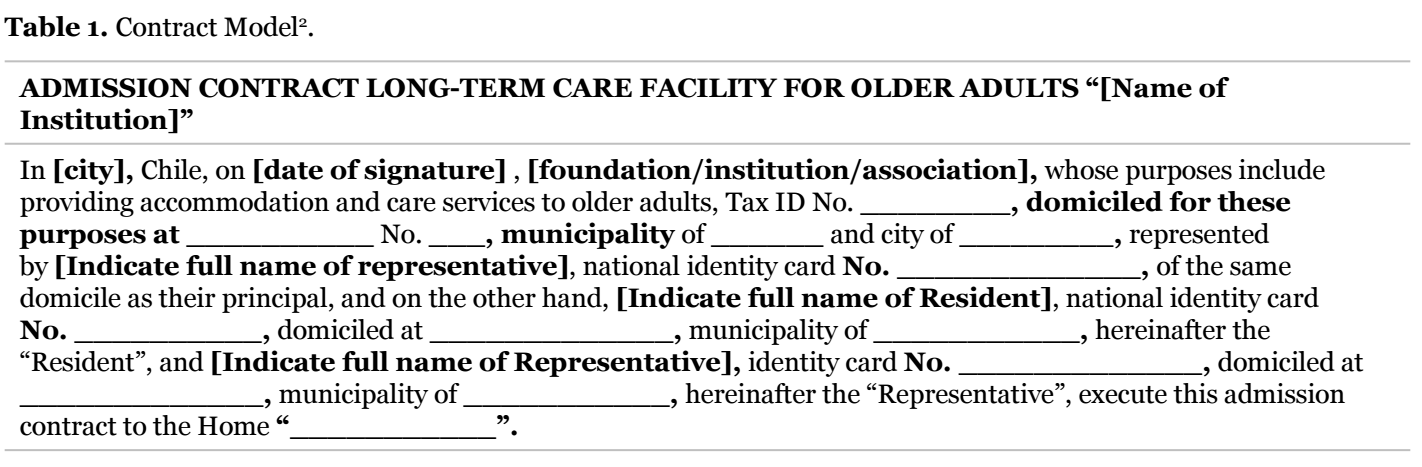
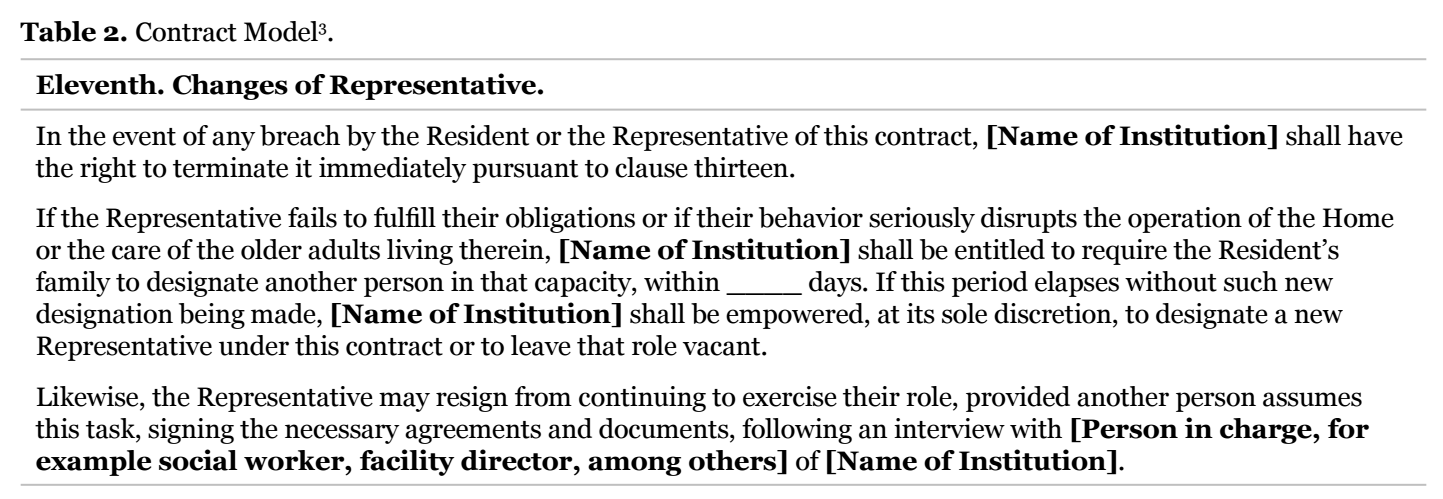
It is also observed in another section of the template available for contract execution with an ELEAM that (1) breaches by the contract’s “representative” grant the Residence the right to terminate it immediately, similar to an express forfeiture clause and as if they were the primary contracting party; (2) in specified cases, the ELEAM can require the older person to designate another representative within a specified timeframe; and (3) if the older adult chooses not to make said designation, the ELEAM is empowered “at its sole discretion” to designate a new representative or leave the position vacant.
2. References to violations of domestic law and treaties in the matter
Regarding domestic law, the situation motivating this analysis—namely, requiring a “representative” when an older adult contracts with an ELEAM—creates tension with various norms, among which we can distinguish constitutional or fundamental norms, statutory norms, and supralegal norms regarding treaty law.
Regarding constitutional or fundamental norms, the specific situation creates tension with the constitutional guarantee of the right to life and physical and psychological integrity, set forth in Article 19 No. 1 of the Political Constitution of the Republic, since decisions are not made directly by the person concerned, constituting at least a threat to these rights or a direct violation of their self-determination; the right to health protection, enshrined in Article 19 No. 9 of the Political Constitution of the Republic, is likewise violated; as is human dignity, which, although not explicitly guaranteed in our basic charter, can be derived as an implicit right or principle under Articles 1 and 5, paragraph 2.
For its part, at the statutory level, the situation in question also violates Law No. 20,584, which regulates the rights and duties of individuals regarding actions linked to their health care, of April 24, 2012, since requirements for informed consent (voluntariness and sufficient, understandable information) are diluted through practices of “delegated” consent to family members and the absence of robust regulation over acts and contracts of older persons.
This practice is especially aggravating when contrasted with what occurs under Law No. 21,430, on Guarantees and Comprehensive Protection of the Rights of Children and Adolescents, of March 15, 2022. Unlike the case under discussion, this body of law expressly recognizes the concept of evolving capacities for children and adolescents, a concept that allows minors to be heard and their opinions considered in all spheres, a standard inexplicably absent in acts and contracts concerning persons in old age.
In international human rights law, violations can also be observed, particularly within the Inter- American system under the Inter-American Convention on Protecting the Human Rights of Older Persons, incorporated into our legal order via Decree 162/2017 promulgating the Inter-American Convention on Protecting the Human Rights of Older Persons, of October 7, 2017; particularly regarding principles in Article 3(c) and (d), namely dignity, independence, active role, and autonomy of the older person, as well as their full and effective participation, integration, and inclusion in society; and Article 7, paragraph 1, regarding the older person’s right to «make decisions, define their life plan, develop an autonomous and independent life, according to their traditions and beliefs, on an equal basis, and to have mechanisms to exercise their rights».
Similarly, the Convention on the Rights of Persons with Disabilities, incorporated into our system by Decree 201/2008 promulgating the United Nations Convention on the Rights of Persons with Disabilities and its Optional Protocol, of September 17, 2008, is violated regarding the recognition of legal capacity on an equal basis for all persons and the replacement of a guardianship/interdiction model with a support system.
And although published, but not yet in force as of the date of this work, we must keep in mind the potential violation of Article 8 of Law No. 21,822, Comprehensive Law on Older Persons and Promotion of Dignified, Active, and Healthy Aging, of June 1, 2026, insofar as it establishes that the catalog of rights of older adults includes rights to independence and autonomy, expressly recognizing the «right to make their own decisions, define their life plan, and develop an autonomous and independent life, on an equal basis with others».
3. Capacity and autonomy of older adults in healthcare
As is well known, legal capacity of individuals (natural and legal persons) is the general rule in our legal order, pursuant to Article 1446 of the Civil Code. Thus, for adults, absent a judicial declaration of interdiction due to insanity or spendthrift behavior, the general rule is to presume capacity, meaning their acts are valid, without prejudice to potential proof of “insanity” (Silva, 2019) at the time of execution, as provided in Article 465 of the Civil Code.
Notwithstanding the above, factual aspects such as cognitive decline (real or presumed) or social factors—such as structural ageism as a form of discrimination—impact the autonomy of older adults when contracting.
Thus, for instance, outside the case at hand, a frequent practice among some notaries in Chile is requesting a certificate of “lucidity” or cognitive competence from older adults starting at age 70 for executing instruments such as property purchases and wills (Ramírez, 2025), despite no law requiring it, and even in the presence of legislative bills aimed at eradicating this practice4.
Autonomy as self-determination and a fundamental right thus faces a conflict between formal and substantive aspects, where despite explicit legal rules establishing capacity, in practice requirements and demands are imposed that are not provided for in our legislation and—despite potential good intentions— impact not only contractual freedom in its various manifestations, but something far deeper: the dignity of the older adult.
In this way, in our field of study, it has been noted that, linked to patient dignity and autonomy, it should be the patient who makes decisions or «at least so it should be, since paternalism in medicine no longer has a foundation» (Vidal, 2018, p. 43). Although this statement is correct under current legislation, in practice it lacks alignment. Thus it is undeniable that, with the requirements present in reviewed contracts, the dignity and autonomy of older adults are hindered or impaired when intermediaries exist in the equation who do not necessarily represent their will.
For their part, as other authors point out:
the existing legal rules in the Civil Code [on capacity] are anachronistic. There are no adequate legal provisions to accompany people through the aging process. Current rules present a dichotomy: one is either capable or incapable. However, this duality does not align with the aging process. In some older adults, physical or mental ailments may develop, and the law only contemplates a cause of incapacity based on insanity. This is not flexible enough for the reality of older adults today (Riveros et al., 2017, pp. 166-167).
Indeed, legal capacity rules regarding acts and contracts are currently subject to legislative revision5. However, under lex lata older adults are currently capable: the issue is not one of lex lata or lex ferenda, but factual.
We recognize that mental capacity as a distinct concept linked to decision-making naturally varies from person to person; however, even when such issues exist, «as noted by the Committee on the Rights of Persons with Disabilities under Article 12 of the Convention, deficits in mental capacity, whether alleged or real, must not be used as justification to deny legal capacity» (Espejo, 2019, p. 6), requiring such capacity to be recognized on an equal basis (Gauché, 2019, p. 120).
4. Depersonalization and infantilization as forms of violence against older adults
As we have observed in light of the case originating this study, and despite domestic and international legislation regulating these matters, paternalism toward older adults persists, primarily manifested through third-party decision-making (family members, medical teams, or the contractually designated “representative” in reviewed templates), which weakens or directly voids the older patient’s will.
In traditional literature, forms of violence against older adults include psychological abuse, physical abuse, care neglect, financial abuse, sexual abuse, and structural maltreatment (Riveros et al., 2017).
Psychological abuse of older adults consists of practices that involve «inflicting mental distress and suffering through verbal aggression, insults, threats, infantilization, humiliation, as well as disrespect for privacy or belongings» (Montero et al., 2017, p. 124).
As noted, this can manifest in multiple variations, such as humiliation, discredit, harassment, “with the common denominator of producing emotional harm to the person” (Court & Wegner, 2011, p. 244).
For its part, physical abuse translates into any form of non-accidental injury to the older adult (Court & Wegner, 2011, p. 244). Closely linked to physical and psychological abuse is care neglect, which can manifest actively or passively: «Abandonment is active when care or basic needs are intentionally denied; and passive when care or basic needs are not provided due to lack of experience, information, or skill» (Court & Wegner, 2011, pp. 246-247).
Financial abuse is a variation of psychological abuse, which may originate from someone in an advantageous economic position relative to the older adult (Court & Wegner, 2011, p. 245). Regarding this abuse, it has also been indicated that one manifestation is “the exploitation or illegal or improper use of funds or other resources of the elderly person” (Montero et al., 2017, p. 124).
In particular, this type of abuse is conceptualized and recognized in Article 9, paragraph 4 of the recently published Law No. 21,822, Comprehensive Law on Older Persons and Promotion of Dignified, Active, and Healthy Aging, of June 1, 2026, which states:
[F]or the purposes of this law, financial abuse shall be understood as the misuse, exploitation, or appropriation of an older person’s property resulting in financial detriment to them, carried out without their consent or with vitiated consent, fraud, or deceit, by third parties.
It adds that:
[F]inancial abuse shall be denominated economic abuse when the detriment originates from a provider and arises in connection with an infraction of Law No. 19,496 on Protection of Consumer Rights. This economic abuse shall be considered an aggravating factor for determining sanctions established under Article 24 of said law.
Regarding sexual violence, it can consist of «exploitation, coercion, or any sexual behavior carried out against the will» (Court & Wegner, 2011, p. 247) of the older adult.
Recently, institutional abuse can also be mentioned, which:
[R]efers to any form of abuse occurring within services aimed at older adult care, where abusers are persons with a legal or contractual duty to provide care and protection […]. Maltreatment can manifest in different modes of institutionalization, whether in home nursing services, continuous home assistance, or long-term residential facilities (Serón & Rodríguez, 2014, pp. 31-32).
Finally, structural maltreatment toward older persons is «[t]hat which occurs from and within societal structures, through legal, social, cultural, and economic norms acting as a backdrop to all other forms of existing maltreatment» (Riveros et al., 2017, p. 164). And it is here that we can contextualize a commonly occurring and invisible form of violence against older adults: depersonalization and infantilization in old age.
As established doctrine points out, one barrier impeding violence detection relates to the terminology used to refer to the phenomenon:
[M]any diverse terms are used, such as maltreatment, poor treatment, bad treatment, inadequate care, neglect, abuse, etc. This means there is no universally agreed term, and each carries different connotations. These different meanings depend, on one hand, on what one considers a situation of maltreatment, and on the other, on the mental image evoked. For instance, the word maltreatment is usually associated with severe and extreme situations seen in news media. While those are certainly maltreatment, maltreatment toward older adults also involves much more frequent situations that can be subtle or pass unnoticed, such as infantilism, silent treatment, ignoring them, or rights violations. Therefore, it is extremely important to reach consensus on terminology to improve awareness, detection, and intervention (Pérez & Chulián, 2013, p. 135).
In this sense, Kayser-Jones develops a four-dimensional model of poor treatment toward older adults: victimization as a manifestation of the above issues, dehumanization, infantilization, and depersonalization.
Dehumanization of the older adult involves acting in an apathetic, harsh, unbenevolent, non-”humanized” manner, focusing on technological and specialized dimensions at the expense of a biopsychosocial approach (Pérez & Chulián, 2013, pp. 65-66).
Infantilization consists of treating the older person as if they were a child, coming from a position of power in interactions. Examples include using childish materials in activities, using diminutives, discussing personal patient matters publicly, using exaggerated tones or loud voices, etc. (Pérez & Chulián, 2013, p. 63).
Finally, depersonalization:
[C]onsists of failing to consider the uniqueness of the older person, their needs, interests, and preferences, treating them homogeneously. While we all share common traits, it is equally true that we are unique. This uniqueness is present in aging, characterized by inter-individual variability reflecting vast heterogeneity and diversity. This makes personalized and individualized care imperative. A person is not merely biology, but also biography (Pérez & Chulián, 2013, p. 64).
In this sense, these last two dimensions —infantilism and depersonalization— are core manifestations of ageism (Martínez & Bermúdez, 2016, p. 147) and concrete forms of violence against older adults regarding their contracting for services provided by ELEAMs, manifesting throughout the entire iter contractual process.
These issues constitute forms of age discrimination in old age, as established in the aforementioned Law No. 21,822, Article 4(d), namely:
any distinction, exclusion, or arbitrary restriction based on age that aims to or results in nullifying, restricting, or denying recognition, enjoyment, or exercise on an equal basis of human rights and fundamental freedoms in political, social, economic, cultural, or any other sphere of public and private life.
Thus, the scenario giving rise to this study— depersonalization and infantilization as forms of violence and discrimination against older adults—is an important, invisible form of maltreatment that nullifies autonomy, violating dignity by limiting decision-making and disregarding actual personal will.
Conclusions
The analysis leads to the conclusion that a tension between autonomy and paternalism in decision-making by older adults exists beyond a theoretical issue of legal capacity boundaries, manifesting concretely in contractual practices that effectively limit rights recognized by the legal order.
The paradigmatic case examined—older adults contracting with an ELEAM—shows that requiring the appearance and designation of a “representative” in contracting is not aimed at fulfilling financial obligations arising from the contract, but connects to personal decisions of the resident, directly interfering in self-determination. This requirement is inherently problematic when there is no declaration of incapacity regarding the contractor or factual basis justifying displacing their will.
Thus, incorporating a third-party “representative” cannot be considered legally neutral. In practice, the older adult’s autonomy is reduced to a mere abstract capacity to contract: consent becomes a purely formal fiction weakened by forced third-party inclusion in contracting and decision-making, lacking concrete safeguards or a relational approach (Calahorrano, 2024, p. 462) to reinforce effective rights exercise.
These practices conflict with a broad and robust set of legal rules and principles: from the Constitution guaranteeing life protection, physical and psychological integrity, health protection, and human dignity; to statutory healthcare rights and informed consent rules; to international human rights law, particularly the Inter-American Convention on Protecting the Human Rights of Older Persons, which mandates recognizing autonomy, dignity, and legal capacity on an equal basis.
Depersonalization and infantilism in reviewed practices, as manifestations of ageism based on stereotypes, wrongly presume incapacity based on age, ignoring the actual capacity of older adults, paradoxically contradicting contemporary principles such as the evolving capacities of children and adolescents, including their right to be heard and have opinions considered across all life spheres.
The recent Law No. 21,822, Comprehensive Law on Older Persons and Promotion of Dignified, Active, and Healthy Aging, of June 1, 2026, is equally significant. Although not yet in force and subject to future practical analysis, it expressly incorporates categories linked to autonomy, independence, and violence regarding older adults, confirming a perspective aimed at overcoming outdated conceptions of aging centered on substitute protection, moving toward recognizing older persons as genuine subjects of rights.
It is necessary to transition toward a model that considers decision-making by older adults valid in itself, in order to effectively respect their dignity: “[a]ll persons, regardless of age, possess capabilities in varying degrees. The proper approach is to enhance them rather than exercise power that diminishes these resources” (Pérez & Chulián, 2013, p. 63).
The challenge lies in implementing decision-making support systems that do not substitute will: providing necessary support where required so individuals can understand, deliberate, and express decisions and preferences, creating conditions for autonomy to be exercised.
Finally, this is not merely a legal issue, but carries cultural and institutional dimensions that must be challenged. Transforming practices requires more than a “cosmetic” change to contract templates; it demands altering training for caregivers and society as a whole, adopting a rights-based perspective recognizing that paternalism in these cases constitutes subtle yet powerful forms of violence disguised as “protection”.
References
Calahorrano Latorre, E. (2024). The relational and life-course approach regarding regulations on older adult autonomy in Chile. In Barrientos Camus, F. (dir.), Family Law Studies VII (455-468). Thomson Reuters.
Court Murasso, E. & Wegner Astudillo, V. (2011): Family Law. Legislation, doctrine, and jurisprudence. Adoption. Alimony. Guardianship. Civil status. Domestic violence, AbeledoPerrot.
Cubillos Román, Y. (2025). The right to care of older adults living in long-term care facilities: rethinking institutional care from a relational approach. In Sabioncello Soto, M. (dir.), Family Law Studies, VIII (pp. 343-365). Thomson Reuters.
Espejo Yaksic, N. (2019). Introduction: Person, autonomy, and capacity. In Espejo Yaksic, N. & Lathrop Gómez, F. (coord. and ed.), Intellectual Disability and Law (pp. 1-21). Thomson Reuters.
Gauché Marchetti, X. (2019). The rights of women with intellectual disabilities. In Espejo Yaksic, N. & Lathrop Gómez, F. (coord. and ed.), Intellectual Disability and Law (pp. 101-133). Thomson Reuters.
Martínez-Moreno, E. & Bermúdez-Pérez, M. (2016). Psychological abuse toward the elderly: variables to address. Spanish Journal of Health Communication 7 (1), pp. 143-153. https://e-revistas.uc3m.es/index.php/RECS/article/view/3161
Montero Solano, G., Vega Chaves, J.C., & Hernández, G. (2017). Abuse and Maltreatment in Older Adults. Legal Medicine of Costa Rica, 34(1), pp. 120-130. http://www.scielo.sa.cr/scielo.php?script=sci_arttext&pid=S1409-00152017000100120&lng=en&tlng=es
Pérez Rojo, G. & Chulián Horrilo, A. (2013). Conceptual framework of maltreatment toward older adults, in Society and Utopia. Journal of Social Sciences 41, pp. 127-167. http://www.acpgerontologia.com/documentacion/maltratoperezrojo.pdf
Ramírez Catalán, E. P. (2025). Notarial capacity judgment. Capacity to act as a right of older adults: the Notary as institutional support, Fojas Journal. https://revistafs.cl/opinion/juicio-de-discernimiento-notarial-la-capacidad-de-actuacion-como-un-derecho-de-las-personas-mayores-el-notario-como-apoyo-institucional/
Riveros Ferrada, Carolina (2019). Older person and cognitive disability. In Espejo Yaksic, N. & Lathrop Gómez, F. (coord. and ed.), Intellectual Disability and Law (pp. 273-291). Thomson Reuters.
Riveros, C., Rodríguez, P., Palomo, R., Alvear, S., Fernández, M. Á., & Arenas, Á. (2017). Structural maltreatment of older adults in Chile and the need to formulate a multidimensional index. Universum, 32(2), pp. 163-176.
Serón D., T., & Rodríguez, M. P. (2014). Review article: maltreatment in older adults. Chilean Medical Students Journal, 7 (1), pp. 24–37.
Silva Bascuñan, P. (2019). On interdiction due to insanity in Chilean legislation. In Espejo Yaksic, N. & Lathrop Gómez, F. (coord. and ed.), Intellectual Disability and Law (pp. 165-189). Thomson Reuters.
Vidal Olivares, A. (2018). Medical Civil Liability. DER Ediciones.
Cited regulations, jurisprudence, and instruments
Bill No. 13822-07, Senate, to promote positive aging, comprehensive care for older persons, and strengthening institutional frameworks for older adults. https://tramitacion.senado.cl/appsenado/templates/tramitacion/index.php?boletin_ini=13822-07
Civil Code. https://www.bcn.cl/leychile/navegar?idNorma=172986
Political Constitution of the Republic. https://www.bcn.cl/leychile/navegar?idNorma=242302
Decree 201/2008 promulgating the United Nations Convention on the Rights of Persons with Disabilities and its Optional Protocol, of September 17, 2008. https://www.bcn.cl/leychile/navegar?idNorma=278018
Decree 162/2017 promulgating the Inter-American Convention on Protecting the Human Rights of Older Persons, of October 7, 2017. https://www.bcn.cl/leychile/navegar?idNorma=1108819
Decree 20/2022 approving regulations for long-term care facilities for older persons (ELEAM), of September 30, 2022. https://www.bcn.cl/leychile/navegar?idNorma=1182129
Law No. 20,584 regulating the rights and duties of individuals regarding actions linked to health care, of April 24, 2012. https://www.bcn.cl/leychile/navegar?idNorma=1039348
Law No. 21,168 amending Law No. 20,584 to create the right to preferential care, of July 27, 2019. https://www.bcn.cl/leychile/navegar?idNorma=1134300
Law No. 21,430 on guarantees and comprehensive protection of the rights of children and adolescents, of March 15, 2022. https://www.bcn.cl/leychile/navegar?idNorma=1173643
Law No. 21,822, Comprehensive law on older persons and promotion of dignified, active, and healthy aging, of June 1, 2026. https://www.bcn.cl/leychile/navegar?idNorma=1224632
National Institute of Statistics (2025). Initial results of the 2024 Census: 18,480,432 people censused in Chile, maintaining the population aging trend. https://www.ine.gob.cl/sala-de-prensa/prensa/general/noticia/2025/03/27/primeros-resultados-del-censo-2024-18.480.432-personas-fueron-censadas-en-chile-manteni%C3%A9ndose-la-tendencia-de-envejecimiento-de-la-poblaci%C3%B3n#:~:text=Envejecimiento%20de%20la%20poblaci%C3%B3n,-Las%20cifras%20presentadas&text=Al%20comparar%20con%20censos%20anteriores,%2C1%25%20en%202017
ELEAM Network (2026). For-profit home admission contract and Non-profit home admission contract. https://redeleam.cl/documentos/# (retrieved: August 16, 2026).
Funding: This article received no funding associated with public, commercial, or non-profit sectors.
Conflict of interest: The author declares no conflicts of interest in the preparation of this article.
Declaration of contributions based on CRediT taxonomy: The author declares her contributions to this research article using CRediT taxonomy: Conceptualization: (100%); Formal Analysis: (100%); Investigation: (100%); Writing - Original Draft: (100%); Writing - Review & Editing: (100%).
Use of AI: The author declares that no artificial intelligence tools were used during any phase of manuscript preparation.
Notes
1Among other measures, given the outlined context, specific regulations for older adults have even been enacted, such as Law No. 21,419, which creates the Universal Guaranteed Pension and amends the legal bodies indicated therein, dated January 29, 2022.
2Adapted from ELEAM Network (2026).
3Adapted from ELEAM Network (2026).
4Among others, in Senate Bill No. 13822-07.
5E.g., among others, Bill No. 14,783-07
Explorar
Artículos
Volúmenes
Sobre la revista
Más leídos
El control externo en la administración del estado. Una visión actualizada
Tarapacá Law Journal (TLJ)
Los hilos invisibles: cien años de las mujeres en el Poder Judicial chileno y los desafíos para el presente y el futuro
Tarapacá Law Journal (TLJ)
The invisible threads: one hundred years of women in the Chilean Judiciary and the challenges for the present and the future
Tarapacá Law Journal (TLJ)
Enfrentando la vulnerabilidad: la reparación integral como respuesta por parte de la Corte Interamericana de Derechos Humanos
Tarapacá Law Journal (TLJ)
Facing vulnerability: integral reparation as the Inter-American Court of Human Rights’ response
Tarapacá Law Journal (TLJ)